Posts

Showing posts with the label cards

Cat Lady: the app

Image
A thread came up on one of the board gamer groups on Facebook where someone asked for a list of board games which have good implementations as game apps, and Cat Lady came up on that list.  We had to check that out. The graphics were perfect, with some cute f/x and music added, and it was easy to get up and running.  Just hit Play then Classic Game.  This defaults to a single computer opponent, but you can add up to three.  It also allows a second human player (and possibly more, we had no reason to check). Against the computer player, the game goes very quickly.  It's over before you know it, and since I tend to pick easy cats to feed (worth lower points) and forget to get toys, I lose about 75% of the time.  It all flows nicely: check your cards and see what you need, maybe feed a cat or two, then swipe some new cards into your hand.  The app organizes the cards very nicely and does all the calculations s you can see that your pick added 5 points, or...

Water Works

Image
To say that Water Works is THE classic leaky pipe game of the 1970s is, well, obvious.  Was there some other leaky pipe game?  Or some alternate 1970s where leaky pipe games were coming out left and right?  I guess it makes sense to put that on the box, for the people who haven't always known about it.  ;-) I played this many times as a kid, and it was probably in my closet full of board games that I gave away a few years ago.  When the little package showed up in my mailbox (from eBay), it was smaller then the box I remembered.  In fact, I remembered that old box so well that my brain has a size category of boxes called "about the size of an old Waterworks box", which is admittedly weird. Anyway, it was a more compact box with just the cards, wrenches, and rules.  The old box had a fitted plastic inner lining that these days would be classified as "waste".  But on to the important stuff ... was the game as fun as I remembered? Yup. It looks like ...

Zoo Run

Image
Following the story told in my previous post, the second game of the day was Zoo Run.  Another card game technically made for kids, but again, it had an interesting card mechanic that I thought was worth checking out. It turns out it's two games in one.  That is ALWAYS a bonus for me, when the game developer thinks up more than one use for the components they created. The first game is about rescuing animals from the enclosure before the mean old zookeeper gets there to stop you.  It looks like this: The way the cards are played, you get three cards, each showing the front or rear of animals at top, middle and bottom.  Players show their cards at the same time, and arrange them to match as many heads and butts as they can.  At first it looked like it might not always work out, but the rules assured us there will always be at least one match.  Here, I completed an elephant, a wildcat and a panda. How the game works: a certain number of tokens are put in the...

Making Christmas

Image
I stopped at the local game shop thursday night and looked around for small, animal-themed games.  Like usual, I forgot to bring my reading glasses, so I couldn't see all the small print.  And when I found two and went up to the register, the guy asked me what age group I was buying these for.  I said we're adults but sometimes the kids' games just have fun twists.  So, okay, when I got home, I had Making Christmas (ages 6+) and Zoo Run (ages 4+).  However, each appeared to have an unusual card mechanic I had not seen before.  So, saturday rolled around and we cracked them open.  Making Christmas was based on the classic Nightmare Before Christmas movie.  Well, they just licensed some characters, but as you recall, when the halloween creatures were trying to imagine Christmas, they put icky toys into presents and scared all the kids.  Good times. Anyway, the game has a little board that cleverly fits in the small box only because it was broke...

Five Crowns

Image
Here is another card game from Set games .  It has almost the same exact rules as their Quiddler game (see the previous post), but here the cards are five suits of otherwise regular playing cards. The first hand starts with three cards and threes are wild, next hand has four cards and fours are wild, up to a final hand of ten cards with tens wild.  It felt like it dragged a bit on the early hands, where we seemed to just be waiting on either an 8 or a 3 or wild, for example.  Bigger hands had almost too many options, too many wild cards, and seemed to just fall together instead of being built using any kind of strategy. One of my first hands. Here, the scoring only uses unmatched cards after one player goes out, with lowest score winning the game.  I never liked games where Jack is 11, Queen is 12 and King is 13, we just used 10 each.  Unused wild cards count 20, unused jokers count a whopping 50, but really, how would you end up not using one? I ended up grabbi...

Quiddler

Image
While staring at our shelf of games, I saw an unopened one that I had no memory of buying, which had apparently been sitting around for years.  It was Quiddler, a word game by Set games .  After which there was another one from the same company called Five Crowns, that we also took for a spin. Quiddler was a solid word-building game with art inspired by medieval illuminated manuscripts.  Both games had almost the same exact rules: start with 3 cards in the first hand, 4 cards in the next, up to a final round of 10 cards; after one player melds all their cards and discards on to go out, all other players get one last turn to do their best.  For Quiddler, it just flowed very simply.  Make words, go out.  Here's a typical hand early on: I got some help from an impartial third party for most of that game ... A bit later on, as the hands got bigger, I was seriously wondering if I could bluff a way to make QUANKERER sound like a real word, only to decide that if ...

Astronomy Fluxx

Image
I got a new set of Fluxx cards, this time it was the Astronomy pack.  Just the planets, some stars, galaxies and space exploration cards.  The problem with special media series tie-ins (Star Trek, Doctor Who, etc) is that some players might be huge fans while others know almost nothing about it.  This deck was a nice change of pace because all sci-fi fans should be familiar with the basics of real-world space history. There were no Creeper cards, which was a plus, and we ran through a few hands easily.  We did get into a mess where we ended up with the MOST rule cards we've ever had showing at the same time in any Fluxx pack; we had already used up the two cards that can reset the rules, so we were stuck with them. There were a few odd cards here.  One was Supernova, which blew up the Sun and all planets, which made about half of the goals unreachable after that.  One was Central Axis which took the largest in-play Keeper of the Earth, Sun, Galaxy set and p...

Cat Lady

Image
 I got a few games in the past week.  Some have been written up already, but here is the batch: Cat Lady is yet another card game with cute cats everywhere.  This one is a bit more involved than Scram.  You work from a 3x3 grid of face-up cards, where each turn, each player can take a whole row or column, then move the cat token to block a whole row or column from the next player's turn.   You can get cat cards or food cards.  The food cards get traded in for food cubes, which go towards feeding those cats.  There are also cat toys, catnip and cat costumes, which score at the end of the turn.  And there are Lost Cat cards: you can trade two Lost Cats in for 2 VP (victory points) or one stray cat.  Each stray cat has a special power like "get 2 VP for each black cat you feed".  Here we are, halfway through a hand. The main 3x3 grid is in the middle, stray cats below them.  My cat cards are on the left, Ann's are on the right....

Nine Cards Down?

Image
It was Anne's birthday, and we were out in the back patio of a relative, when one of her cousins out of the blue picked up the deck of cards that was sitting there and asked, "Have you ever played Nine Cards Down?" Oddly, no.  In my nearly 50 years of gaming and collecting rules of games and game history notes, I had never heard of that one.  I know that each family has a serious card player or two with a favorite game, but the list of common games is really quite small.  We play 500 Rummy and Gin Rummy, and Anne used to play Canasta with some friends.  I have seen some cribbage boards sitting on tables or counters in several houses in the pandemic year.  Then there are Hearts and Spades.  And Solitaire, but again, almost everyone plays the Klondike style even though there are a few dozen others available.  Let's just skip Poker, just no.  And that's just about it for household card games.  Nevermind all the apps.  I mean real cards. Her...

NMBR9 - Tetris with numbers

Image
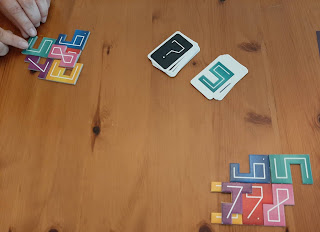
NMBR9 is an odd little game I got about a year ago when I drove over to Oceanside to buy a big stack of board games from a guy on Facebook.  I didn't get a chance to look at it until now.  Unboxing is fun, punching out all those thick cardboard numbers and stacking them in the number-shaped spaces in the box. This is a sort of Tetris-style shape fitting game using numbers with intentionally awkward shapes.  Really, you just shuffle the short stack of cards and then flip them over one at a time until they are gone.  If the card shows a 3, all players take a 3 and try to add it to their layout. So easy!  Except for the awkward shapes that often don't fit anywhere.  The trick to building the layout is that a number tile must be placed alongside another tile, or on top of two or more numbers.  With NO gaps beneath them.  And then the scoring is a matter of deconstructing the pile where the bottom layer counts zero, the first layer on top of that count...

SCRAM: cute cats for everyone

Image
SCRAM is a card game of cute cats, trying to score the best combos.  We goofed the rules the first few rounds, thinking we could have more than one active pile.  But there should be just one active cat, and when you score a cat you move it to your "Cat tree". The basic gameplay is: draw a card (from draw pile or one of the face-up cards in the "Pet Shop"), then either 1) add a card to your active cat if it's one more than the top card showing, or 2) throw a 0-point "stray cat" on an opponent's pile to slow them down, or 3) if you really have no moves, turn in your full hand and drew 5 new cards. Now, a stray cat can be immediately blocked by a Scram card, and you can "bank" a cat at any time by moving that pile to your cat tree and starting a new pile.  There are a few STEAL cards in the deck that let you take th top card from an opponent's stack if you can play it right away. Some of the cat cards have special rules printed on them, ...

Chem Rummy (1974)

Image
Here is another super rare card game I have kept since I was a kid.  My dad was a chemistry teacher, so I have always had an interest in molecules and all the possible combinations of elements, and the ongoing research that pushes the boundaries of new types of chemicals. Here is Chem Rummy, from Addison-Wesley, 1974.  It's not even mentioned on BoardGameGeek, and I have no idea how many were printed or if they are still available.  I never could get another player to sit down and build chemical formulas with me, but the idea was to play exactly like gin rummy: draw and discard cards until you can lay down your whole hand of cards as a valid set of molecules. But I always played it like regular solitaire: make the seven piles of one to seven cards, play and move the cards exactly as in regular solitaire, turn the extra cards three at a time, and see how many combos I can make before the cards run out.  With this deck, you do eventually end up with just number cards a...

WordSpiel - making words with that last letter

Image
We did a test drive of a new card/word game this weekend, this time it was WordSpiel.  The basic idea is that you have to play a word using the last one, two or three letters of the last word played.  It started off easily: The rules show the words building into a perfect spiral around the draw pile, but, well, that's never going to happen.  What a pain... The first thing we decided was to reset the spread of played cards when it started to get too ragged.  Really, the game is so simple, there is no grand strategy, so we don't need to know every card that was ever played. There, nice and tidy.  Goodbye, impossibly neat spiral.  Anyway, it was an enjoyable way to burn through some cards on a sunday afternoon and make sometimes funny combinations of words.  The only other rule of note is that if you get stuck without a word you can trade in up to three cards as your turn, or flip the top card from the draw pile after you first say whether you are going t...

Disintegration (1974) - fun with nuclei

Image
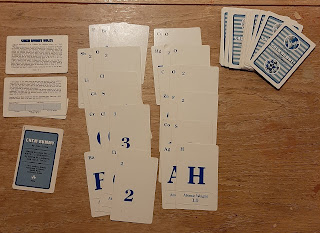
Wow, I found a game that's not even mentioned on BoardGameGeek.  Disintegration is a science card game from Relativistics, 1974.  I had this when I was about 13, so I first saw it in 1979.  The idea is to take a chart of the nuclides (all known isotopes organized by atomic weight and neutron count), put your pieces on lead (Pb), and play cards to decay your way all the way down to Hydrogen (H) without going off the chart or hitting a stable isotope which could never decay further in nature.   Sure, that worked way back when.  It wasn't just nerdy, it was nuclear physics, with cards showing how alpha and beta decay and other nuclear events work.  Plus some cards called "Improbable process" where you can play combos that never happen in nature. The cards are still fresh and new... But we have since discovered hundreds of new isotopes.  So look at how crazy big the chart is now.  Even on a scale too small for the plastic pieces to fit in the squ...

Bali (1954) - card game making words

Image
I found a 1954 blue box version of the card game Bali in my collection of card decks.  Yes, if you put stuff away in the closet for years, seeing them again can be like going to the store.  Anyway, I remember trying it once before and being unimpressed, but this time we took some time to read the rules more closely and tinker a bit.  The tiny rulebooks from that era were full of ambiguous phrases, and just don't match the precision of modern rule sets now that decades of "rules lawyers" have hashed them out over gaming tables. It turns out to be a solid game.  Let's focus on the two player game, since we are a two player gaming group.  You get 7 columns of cards, like in standard solitaire.  Each column is called a "panel", so each player has 7 panels where they will be building words or parts of words vertically downward. The first few runs we tried it with just 5 panels, since it felt like 7 was too many. So, each turn you can add onto any ONE of your pan...

Wizard Kittens

Image
We're back with a new playthrough, this time it's a card matching game called Wizard Kittens.  So, the idea is that you are kittens trying to clean the master wizard's lab while he's away, so you are supposed to match ingredient cards to the combinations shown on curse cards to clear the curses and score the points ... before the boss gets back. Setting up the game is a bit of a pain the first time, about 7 different types of cards that have to go in the right places.  But resetting for a second game is much easier, since they are already sorted by type, more or less.  I don't really like games with long setups, but it had a nice clear guide for what goes where.   Here's a look at a game in progress.  Anne's cards are up top facing left, my cards are bottom left, and the curses we are trying to clear are in the middle.  Each turn, a player gets one of four moves: draw a card, discards two cards, move a card to another player's hand, or swap two cards. ...

Fluxx games

Image
Do you ever get tired of card games that have the same boring set of rules from start to finish?  Yeah, that is so normal.  Snore.  In Fluxx, the goal is sooooo simple, just play two "Keepers" (green cards) that match the current Goal (the pink that is showing).  Out of a deck of about 90 cards, you would think that would be both simple and dull.   But in Fluxx, there are cards that modify the rules themselves.  So while it starts off as draw one card and play one card, the rules might change to draw three and play all, plus all kinds of weird bonus rules like trading in cards for other cards, allowing a second goal, limiting the hand size or how many keepers can be showing.  So, perfect name, Mr. Looney (actual name) ... the rules are always in flux. Here is a round of Fairy Tale Fluxx after just a few moves: the rules are Draw 4, Play 2, and the goal is the Princess and the Frog.  But wait, if you get the princess, the other player can yoin...

Mystic Market

Image
Here is a magical crafting card game with a unique prop: the market itself is made up of 6 little vials of colored powder on a sloped rack. The card trading is pretty simple, just a few basic actions to get, buy or swap to acquire the ingredients you need.  You can trade in ingredients for coins in sets of 2, 3 or 4, whichever number is on the cards.  Or you can trade ingredients for one of the potions that are showing.  The potions let you get more ingredients, or bonus coins, or even get paid a few coins to steal a card from another player.  The way the market works is that when you sell ingredients, you move the colored vial for that ingredient back up to the top, and the others roll down, sending their prices up.  Or there is a Supply Shift card with a blurb that's fun to read, which will cycle all vials until the selected color is at the lowest point on the slope, the highest price. I tried to work out a solitaire version after our first few test runs....

Mille Bornes and previous races

Image
  One of my favorite basic card games as a kid was Mille Bornes, a simple car race simulation deck.  There are mileage cards (25, 50, 75, 100, 200), Stop and Go lights, Speed Limit cards, and then a fun combination of obstacles you can throw on your opponents to slow them down.  These are: Accident (negated by a Repair card), Out of Gas (cured by an Extra Gas card),  and a Flat Tire (fixed with a Spare Tire card).  There are also special immunity ("safety") cards, one for each obstacle. It's a simple game of throwing down mileage and trying to screw up the other players.  I always just draw a little race track, it's easier than trying to keep stacks of numbers sorted out; it's essentially a graphic display of our progress, and it's more fun to look at than a stack of numbers.  In the official rules, you are supposed to need a Go card to get started or after removing any obstacle, but we always drop that rule.  Life is just too short to wait for Go...