Posts

Showing posts with the label small

Fun with 3x3 boards

Image
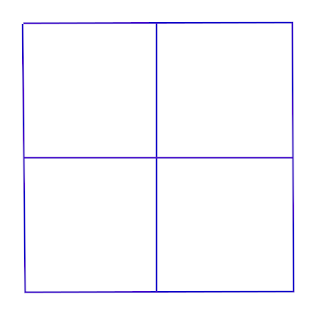
 I'm sure that most Westerners, who grew up on chess and checkers and coloring books, and are told to always stay within the lines, will think of Tic Tac Toe when I mention a 3x3 board game.  Sure, if you want to stay inside the boxes, that's what a 3x3 grid looks like. But many games are played on the lines, not on the boxes.  So here is a basic 3x3 grid.    If you are still seeing a 2x2 grid, let me show where the pieces would go.   What makes this easily-drawn board so neat and compact, is that the lines show how and where the pieces can move. Technically, that simple board is used in a game called (not surprisingly) Nine Holes .  The basic rules for all games on this page: - each player gets three pieces, the pieces start off the board - take turns adding pieces to the board - once all pieces are on the board players can move one piece one square each turn.   - Winner is the first to get three in a row. It's not the most exciting thing, b...
The Smallest Board Games

Image
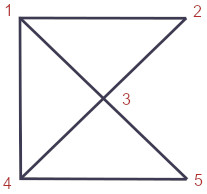
After my last post about the oldest known board game artifact, it might be fun to describe the smallest board games in history.  You might think of Tic-Tac-Toe right away, but that has nine whole spaces to play on.  The smallest I could find was a Chinese games called Pong Hau K'i, which has only these five spaces: Player one starts with pieces on 1 and 4, player two puts their pieces on 2 and 5, and the winner is the one who can blockade their opponent.  It is just a minor exercise, and a game should either end quickly or go on forever.  Over at Cyningstan , this game is also called Horseshoe. A similar game from Korea, called Umul Gonu uses the same board (though in a more circular shape) but Player A starts on 1 and 2, player B on 4 and 5, and the obvious one-move win of 2-3 is forbidden. From here we can move on to a 7-space board: For a game called Madelinette, player A starts on 1, 3 and 6; player B starts on 2, 5 and 7, and it is another blockade game.  T...