Posts

Showing posts with the label board

Pirate and Traveller (1954)

Image
I first heard about this game a few years ago.  The first edition was 1911, but of course that one is $100+ if you can find it at all.  The 1936 edition is almost as pricy, but I was finally able to get the 1954 edition in near mint condition and set it up. First of all, I love moving pieces on actual maps.  I also enjoy being the geography textbook who can help anyone find any spot in any country, thanks to my lifetime hobby of collecting stamps from every country.  For some of the places I even found myself starting brief history lessons. This map is very well done.  It is not a graphical marvel by modern standards, but it captures the look of a page from an old atlas of the time period.  The travel routes are very well thought out, and match what I know of the history of trade routes.  The paths all make sense, and that skull in the South Atlantic Ocean fits where St. Helena or Ascension Island would be, so for a geography lover there's more than ju...

The Six Million Dollar Man

Image
This game was in that batch of unrelated games I got this week.  I wasn't expecting much from it, and it delivered pretty much as expected.  It is just a roll-and-move game with the most pointless deck of game cards I have ever seen.  The cards all just say Power, each one worth one Power point.  It also had one of those silly spinners from 1 to 6 where they could have just used a regular six-sided die instead. The game had a few twists, like splitting the path into four separate "missions", though the missions feel exactly the same.  At the end of each mission you have to spin over a four or five (depending on the mission) to move to the next mission or win the game if you're on mission four, and if you fail the roll you lose a Power card and try again next turn; after two fails we just move to the next mission to quit stalling.  The blurbs describing why you lose cards or lose a turn vary from one mission to the next.  We ended up just throwing the p...

Kill Doctor Lucky

Image
I was going through my shelf of old RPG books recently and found my original copy of Starbase Jeff tucked away on a shelf.  This was one of the low-cost classic games created by CheapAss Games back in the 1990s.  It came in a paper sleeve and had just the instructions and space station tiles you would need to play.  The designer knew that we already had heaps of dice and tokens and pawns to use, so he only printed the unique items.  They were always twisted, quirky and fun.  Yup, James Ernest, someone I really admired as a game creator.  Blast from the past. I had an urge to Google him and see where his creative mind ended up.  Not only is he still around, but there is still a website for CheapAss Games , and he put about 20 of their old games on their website as free print-and-play versions. It was fun to see them again, including ones I had never seen back then, and ones I had never heard about.  And of course, Kill Doctor Lucky, which works fin...

The Checkered Game of Life (1860)

Image
This was the first game by Milton Bradley , who was real person with quite a story.  It dates all the way back to 1860, and here is an excellent article on the early days of his game company.  It is played on a basic checker board with each square showing different virtues, faults, points, or arrows to other squares.  Here is my version of the board, with one difference from the one shown in the article.  We'll get back to that in a bit. There were similar games at the time, and they were played by starting in the bottom left corner and moving as in Snakes & Ladders: bottom row left to right, then up one, next row right to left then up one, next row back the other way.  When writing is done in this way the pattern is called boustrophedon, which is one of my all-time favorite nerdy words. But there was an extra piece to this game which shows the actual movement scheme of the game. Each player would get one of these cards with the scoring dial and move chart....

Mad Magazine board game (1979)

Image
Back on the tabletop, we finally broke out my copy of the Mad Magazine Board Game from 1979 that I got about two months ago.  It looked like it would be in the gag-filled "dopey" category, and I was not far off.  But it provided plenty of laughs and "ugh" moments, and was actually a lot of fun. First, it was clear that the rules insert was missing, but that was easily located at BoardGameGeek.com , but the only important detail was how much starting cash you get.  After all, the box bottom boasted that the object of the game was to be the first to lose all your money, and the game board spaces and cards were quite specific enough. So you start with $10,000.  That's really all you need to know if you're missing the rules sheet.  There a few other rules but you could probably guess them: if you land on an arrow box, roll one die and begin on the inner track (like in Careers), only using one die while on the inner track.  And if you take the money from Tough ...

Outdoor Survival again

 Continuing the bits of board gaming on our four-day weekend, next up was the old classic Outdoor Survival (Avalon Hill, 1972).  Big points for Anne for being adventurous enough to give it a shot.  I've had the game since high school and even then it was hard to find anyone to play it again after the first game or two.  The most common reaction would be "Yeah, I want to spend another 3 hours dying of thirst ten different ways," and the guys would rather play something massive (usually Rise & Decline of the Third Reich) instead because at least they would get to blow some stuff up. I always run game one as a basic intro with the Lost scenario.  It has pretty harsh food and water needs, and for a player's first run, just ignore the Wilderness Encounter rules on the back of the scenario cards.  A few ways to nerf the game to prevent a rage quit: let shacks count as both food and water, and let movement along a river be 2 points per hex and count as a singl...

Outdoor Survival (1972) - Avalon Hill classic

Image
I had Outdoor Survival on my game shelf since the 80's at least.  A few years ago, I gave my board game collection to a family who was having actual board game nights.  At the time I had no players at all willing to come over and game, so it felt like a good move.  Now I wish I had half of those games back.  Not all of them, because THAT would be mental.  But some of them were classics, like Outdoor Survival. It's a famous game board, which is described as "13,200 acres of the great outdoors".  A three-part heavy folding board, and yes, the little plastic clips that are loose in the box are meant to hold the parts of the board together. The rules start you with a basic game, where you start at the base (number 5) in the middle of the board, and the first player to make it off the East or West edge of the board wins.  Here I am a few moves into a solitaire game. The basic rules are simple: roll a die to see your movement options.  Move.  Repea...

Blizzard of 77

Image
I discovered the "Blizzard of 77 Travel Game" through eBay searches for other games.  I don't remember what I was looking for, but it came up as a suggestion and looked like a lot of fun.  Having grown up in upstate New York myself, we lived through some crazy snowstorms as a kid, before the family moved to Long Island, so it was a fun topic.  I was able to reconstruct the board in my notebook of game design history, but there's no substitute for getting the real thing.  What you can't easily reconstruct from images or other people's game stories are the decks of event cards.  Not to mention the feel of the nice thick game board.  So, I found a near-mint copy listed for about $30.  With shipping, it was about the cost of a mid-range new board game. You start out on the Sunny Side of the board.  The goal is to get to all five locations and collect a card from each one, then get home for the win.  So here we are on the Sunny Side... When you la...

CAREERS (1979) - dang this is fun

Image
I was bored late at night and was browsing through some Facebook board game seller group, listings of the same common stuff over and over.  Then someone was offering a like-new copy of the 1979 game of CAREERS for a few bucks plus shipping.  It got here yesterday, and not only was it somehow crisp and new, but it was way more fun than I remembered. Now, I had found screen shots of 4 or 5 different editions of this classic game online, but the tiny text in the career boxes made them unusable and print-and-play test runs.  With each new edition, the career paths changed, each fitting their decade.  It is a fascinating history. Sometimes when people say they remember the game of LIFE, ask them if they remember the little cars with the people pegs, or the spinner popping off and wiping all the cars off the board ... if they don't remember that, I suspect they were actually remembering CAREERS instead.  The two games occupy a very similar niche, but in different ways...

KingDomino - tiny empire building

Image
A while back, I got Kingdomino from Barnes & Noble.  It was so colorful, and we didn't have any games yet that wrapped a theme around domino-style play.  It turned out that I actually bought a deluxe edition which included a Royal Bonus Pack and the Giants Expansion.  Let's stick to the base game for now.  We got the domino selection rules wrong the first time around, but once we got the scoring worked out, there was a fun little genius behind this one.  The tiles have numbers on the back, 1 through 48.  The higher numbers are tiles that will probably score higher but be harder to place in your layout. You start with a home tile and a little 3-d castle to put there.  Then the goal is to build a 5x5 kingdom with adjoining areas of matching terrain.  Each domino shows two terrain tiles.  Say you end up with four connected desert tiles, and one of the tiles shows two crowns ... you get 4x2 points at the end of the hand. That's it. For two pl...

Baba Yaga - what just happened?

Image
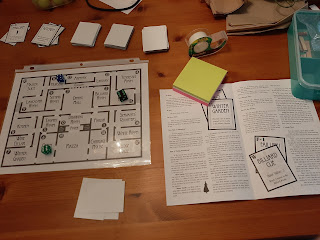
I got the game of Baba Yaga at the local game shop.  I have liked the look of this series of games for a while now; they are designed to look like old tomes full of secrets.  It came with a big story booklet, so you get "a story and a game".  And Baba Yaga is one of my favorite strange characters from Eastern European mythology. Unpacking it, it looked great, and it was fairly enjoyable figuring out the rules.  But it had some weird physical component that we just found annoying.  Overall, it's a simple game where one player flips tiles and tries to find the 3 or 4 ingredients that match the card in their hand.  Meanwhile, the other player(s) are moving the witch figurine back and forth across the spaces at the middle of the game layout, counting down how much time they have left. That is all quite enjoyable.  Moving the witch as a sort of timer was a fun, ominous game dynamic.  And there are cards that can add or remove one space from the witch's...

Make Your Own Opoly

Image
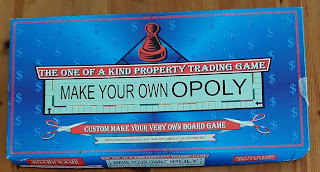
Following up on the last article, the same day I found the 1972 British edition of Monopoly, I also grabbed what seemed like and oddity, called Make Your Own Opoly.  I never cared for all of those themed, skinned editions of Monopoly.  It was a bit amusing early on, but now every state and town has an edition of their own, every major TV show, movie editions, Star Wars, Simpsons, Las Vegas, Harry Potter ... argh.  Sometimes it's nice to see a store have a section labeled "Games" only to have it be just 20 or 30 funky clones of Monopoly, as if there was nothing else available in the world. So this one just struck me as odd. Early on in my programming career, about the first project I would do to learn a new language would be a few bits of D&D (of course) and then a simple board game, almost always Monopoly, because it was so universal and had a good variety of features (board, cards, money, properties) to write code for.  Back in the shareware days, I had a clone ...

Gaming with Poirot

Image
This is going to be a tale of a very odd coincidence.  Anne & I have been watching the old Poirot series with David Suchet as the best Poirot ever.  The episode 'The Lost Mine" opened up with Poirot and Hastings playing Monopoly.  The story was meant to be set in 1935, and it felt a bit early, since the 75th anniversary of Monopoly felt to me like it was just a few years ago.  But in fact, Monopoly was first released on a large scale in late 1935.  And that 75th anniversary was so ten years ago. Then I noticed that the money was the "wrong" color.  So when it came up that Poirot won a beauty contest and collected "10 pounds", of course, it was the British edition.  Here it is: But was there already a British edition by 1935?  Turns out, yes, and instead of rushing to the internet to answer that, I found out in the strangest way. Three or four days later, while taking the dog for a quick walk around the block, some neighbors were throwing boxes...

Game of the Goose

Image
What seemed like a pretty simple kids game from the 1600s to 1800s turned out to go so far down the rabbit hole, I can't even think where to begin.  The Game of the Goose was a simple roll-and-move game, generally a spiral with 63 spaces, ending in the middle.  If you land on a space with a goose, you roll again (or leap forward to the next goose), but there are other spaces along the way that send you forward or back, or swap spaces with other players, or sometimes pay a chip penalty, or simply die ... it's sounds like just another race game, right?  But you have to read the rules on each board very carefully; some are steeped in symbolism or strange morality plays, where the same layout is popularly used for tourism of countries or cities full of fine renditions of places to see. A lovely introduction can be found at tradgames.co.uk. You can search almost any major museum site, the Metropolitan , the Louvre, the British Museum , and all of them will have a cache of thes...

Tsuro

Image
Probably the simplest modern game in my collection which is fun to replay any time is ... Tsuro.  It is a fine, lavish production on every level, a joy to unbox each time.  Open that red folder to refresh my brain that the rules really are as simple as I remembered.  Then flip through their gorgeous catalog, then peel back that lovely vellum sheet with the logo on it to get to the sturdy game board. "The Game of the Path", indeed.  Just deal three tiles and set up your piece at any mark around the edge of the board, then take turns placing tiles in front of your piece and moving all pieces to the ends of their paths.  The last one left on the board is the winner.  And that is essentially all there is to it.  I can't think of any useful strategy tips other than the obvious point of trying to stay away from other players and away from the edges of the board.  Still, a tile can set you on a path that takes you all the way across the board and off ...

Patolli

Image
Patolli is a cross-shaped game of the "race around the board" variety, from Central America, possibly as far back as 200 BC.  It is also the center of a century-long dispute about whether a game from the new world, which is very very similar to Parchisi (from India) could have been independently invented, or obviously borrowed.  In this case, the trouble is that the early reports are from the early 1600s, from Spanish conquerors who were not necessarily reliable observers.  There are really only three possible answers: - Yes, the New World game was borrowed from some Old World source, but rather than proving some highly unlikely link between cultures, maybe a single missionary brought it over and it caught on much later than the stories would have us believe. - No, there was no borrowing, it was a purely local invention.  Sure, both games toss 4 or 5 binary objects (beans for Patolli and cowrie shells for Parchisi).  Yes, both boards are cross-shaped, but it's n...

Puluc

Image
Another ancient board game, Puluc (also known as Bul or Boolik) is from Mesoamerica.  There are interesting debates about its exact origin, and whether or not it predates the Spanish conquest of the region.  It is a simple game, just a track with nine spaces, but it is a relaxing little challenge that does get tactical at times. The best sources for information are the usual suspects: BoardGameGeek , Cyningstan, a4games and an overview from Wikipedia . The basic board looks like this (my quick version): But, in keeping with the endless creativity of game board makers, there are versions with 10 spaces, up to 25 have been reported, and the Wikipedia image shows a board designed in a circular pattern. The basic rules are: 1. Setup 5 red pieces in the red zone ("city"), and 5 blue pieces in the blue zone. 2. Each turn, throw the 4 two-sided casting sticks to see how many spaces you can move.  If no sticks land face-up, that counts as 5 spaces. 3. move any one piece the num...

Fun with 3x3 boards

Image
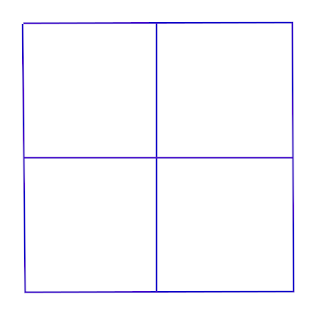
 I'm sure that most Westerners, who grew up on chess and checkers and coloring books, and are told to always stay within the lines, will think of Tic Tac Toe when I mention a 3x3 board game.  Sure, if you want to stay inside the boxes, that's what a 3x3 grid looks like. But many games are played on the lines, not on the boxes.  So here is a basic 3x3 grid.    If you are still seeing a 2x2 grid, let me show where the pieces would go.   What makes this easily-drawn board so neat and compact, is that the lines show how and where the pieces can move. Technically, that simple board is used in a game called (not surprisingly) Nine Holes .  The basic rules for all games on this page: - each player gets three pieces, the pieces start off the board - take turns adding pieces to the board - once all pieces are on the board players can move one piece one square each turn.   - Winner is the first to get three in a row. It's not the most exciting thing, b...