Posts

Showing posts with the label tile game

Wooly Wars

Image
We got to play a round of Wooly Wars in the back yard today, under the shady canopy.  Our little round table was barely big enough to hold it, and the last few tiles had to be put somewhere else because we ran into the edge.  Here is the BGG page . This is a simple tile-placing game, trying to build the largest enclosed sheep pen of your color.  You oddly start off without showing which color you are playing. A sheep pen is enclosed by fences or forests, and if a wolf is placed in that adjacent forest, all connected pens are threatened, though a hunter tile can cancel out a wolf tile.  In the end, the protected pen with the largest population wins. There are some odd extra rules that happen in the middle of the game, like exposing which color you are playing.  With two people, it felt irrelevant.  Then there is the shepherdess tile that lets you change colors, also irrelevant.  You can also choose to stop placing tiles and take a bonus; I think the fir...

Boop Shuffle

Image
This is a card game version of Boop, which we reviewed here . We had vague recollections that the original Boop was cute but confusing.  It was hard to visualize the moves when each cat or kitten played booped the tiles around it. Boop Shuffle perfectly catches that same confusing feel in a tiny deck of cards.  It is still for two players only.  There are two little rolled up strips that you can put down at right angles to represent the edges of a 6x6 game board.  The original Boop was much better in this respect, with the cute "turn the box into a bed" motif. Here, you still try to get three kittens/cats in a row to promote the kittens to cats, thought it's done in an obtuse way by putting the promoted cats into the discard pile.  So they will be available the next time the discard pile is shuffled into a new draw pile.  It was a bit disappointing just drawing a card and playing it, even if it's the other player's cat. There are a few variant cats, and one...

Nimalia

Image
This l looked like a cute biome building game, and that's about right.  But it was remarkably cryptic.   The objective for each of the five rounds came from a uniquely weird set of objective tiles. The goal is to build a nature reserve that fits in a 6x6 grid using tiles that each have for squares on them.  On each round you take the new tiles.  Keep one and pass the others. Then all plays play their chosen tile.  Then choose one more and pass the other.   Play that tile then play the last tile.  Figure out the score from the objective grid and move on to the next round.  There are five rounds total. Your tiles can overlap but must stay within the 6x6 area.  Translating the symbols on the objective cards, our game had points for separate green biomes, solo pandas, minimal giraffes and length of river.  The page in  the rulebook that describes all the objective es is so dense with little icons it just hurt our ...

Deep Dive (Flatout Games, 2023)

Image
We never get tired of trying out new games.  When we opened Deep Dive yesterday and saw all the sheets of pieces, I was worried that it might turn out to be too complicated for our quick, casual play sessions.  It turns out that there ARE a lot of pieces, but the gameplay is simple and just a bit different from anything we had seen before. All those pieces represent five different layers (depths) of the ocean, with the lower layers in darker shades of blue, and with one to five pips showing which layer each chip belongs to.  For less than three players you start by taking out all the tiles with a (+) sign on them, since those are for 4+ players only.  Then you remove some number of tiles from each depth to balance the number of players, then group up the tiles for each depth face down, and that's it for setup. Each player gets three penguins.  On your turn, one of your penguins dives in to the tiles at Layer 1.  At each level you have to option of flipping ...

Triqueta

Image
Triqueta looked like it would be fun and different, production was solid and the tiles were big and sturdy.  The setup was a pain (especially when one of our gaming group has shaky hands): getting all those pointy pieces into the perfect stacks.  Meh.  I guess they could have just been piles.  They looked nice in the clean stacks with the big tile for a lid.  My own hands were shaking by the time I got them all lined up and pushed together. It turn out that gameplay was odd.  When I read the rules, it sounded so simple: just pick a tile and either keep it face down or add it to a line of tiles, OR take a line of tiles and end your turn.  There are a total of four turns, and the face down tiles were limited to two PER GAME, not two per turn.  So we got it wrong first, then we tried a round with no face-down tiles, then we added the face-down tiles rule after we got a feel for the rest of the game. The scoring is easy: you try to make a triqueta (3-...

Peace by Peace: Succulents

Image
We got Peace by Peace: Succulents a few weeks back at the Toy Box in San Clemente, CA on the way back from a weekend trip.  I also got the cactus-themed game "What's the Point" in that same batch, so it was an odd pair.  Two of the types of plants I used to grow back when I had space to grow things. Anyway, Peace by Peace is not really a game, it's a series of 50 puzzles.  There is a set of 45 triangle-shaped tiles with colored leaf patterns in each corner, then a set of 50 cards giving puzzles to be solved.  Each card list which numbered tiles to use and shows a few starting cards by their number, but not what position they're in, followed by some empty spaces and possibly the colors of a few other corners. The challenge is to work out how to complete the pattern using the tiles available.  It's a bit annoying finding those tiles to setup the puzzles, but we settled on stacking them in piles of 1-9, 10-19, 20-29, 30-39 and 40-45.  Then we could easily find...

Azul (finally)

Image
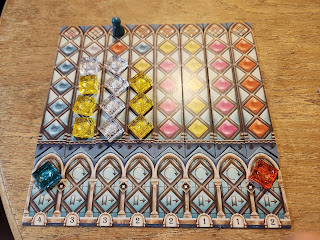
I bought Azul about a year ago, but after opening it I thought it might have too many pieces or too many rules to fit our comfort zone.  It certainly is a vibrant and gorgeous design with nice thick pieces to collect. It's not as complicated as I thought.  Like usual, our first run through was a stripped-down version, and then I add one or two other rules each time we play again.  Azul didn't need much of that treatment.  You basically have a game board with about 8 panels and a guy marking which panel you're on.  You try to collect the glass pieces you need from the central "factory".  You can only add to one pane in a turn.  If you complete a pane, you put a piece on the track below it and score all completed panes from there to the right, then flip the pane over.  The second time, you score and remove the pane entirely. Your marker shows your current pane, and you can only place pieces on panes from that pane to the right, never to the left of ...

Land vs Sea

Image
I got Land vs Sea a few months ago but we never had a chance to try it until yesterday.  It looked like a pretty simple tile-placing game, and sure enough, that sums it up.  Each player has two tiles in their hand, and each tile is two sided.  So you have 4 patterns you can play.  Some have a symbol to play again, and some have a symbol to steal a tile from another player.  Otherwise, each turn you play a tile and try to complete a land or sea area, depending on which side you're playing. To actually capture some areas is a lot trickier than you might think.  After a while, I found myself counting how many land edges or sea edges I need to complete each area.  But sometimes, just having the land-land-sea-land edges you need doesn't mean the tile solves the problem for you.  That piece of land of arm of the sea might escape in a new direction. When you do complete an area, you get one point for each tile the area appears on, plus one point for any ...

Coral Islands & Bohemian Villages

Image
In between real life things and some Mincraft sessions, and spending too much time on those little app games that keep asking for a dollar here or $2.99 there, we got some actual board game play into the mix.  First, I brought over Coral Islands, which turned to be 3 different games in one box: Coral, Islands (flip over the little game mat and use different cards), and a solo game I intend to try some day.  This is a dice-stacking game that comes with about 80 dice.  You make vertical stacks of up to 3 dice, one at a time, and try to match the patterns on the cards.  Match a pattern, take a card, and it sounded almost too simple to be worth the hassle of working through the specific setup situation.  But after there are a few dice on the mat, it's obvious that it's not as simple as it looked. First, a die can only be placed on a die of lower value (or an adjacent empty space), except for ones which can be placed on any number.  And you get fish tokens for n...

Tsuro

Image
Probably the simplest modern game in my collection which is fun to replay any time is ... Tsuro.  It is a fine, lavish production on every level, a joy to unbox each time.  Open that red folder to refresh my brain that the rules really are as simple as I remembered.  Then flip through their gorgeous catalog, then peel back that lovely vellum sheet with the logo on it to get to the sturdy game board. "The Game of the Path", indeed.  Just deal three tiles and set up your piece at any mark around the edge of the board, then take turns placing tiles in front of your piece and moving all pieces to the ends of their paths.  The last one left on the board is the winner.  And that is essentially all there is to it.  I can't think of any useful strategy tips other than the obvious point of trying to stay away from other players and away from the edges of the board.  Still, a tile can set you on a path that takes you all the way across the board and off ...