Posts

Showing posts with the label modern

From RIsk to Warzone

Image
I played many fun sessions of Risk over the years.   There is something deeply enjoyable about getting together and putting little troops on a map, and trying to outmaneuver each other.  Of course, there is also that epic, grinding sense of doom and failure when the forces start to close in around you ... and the in-person game might still drag on for another hour while your world dwindles to nothing.  At least with the software versions, you can rage quit if you need to. ;-) Each group of gamers probably had some of their own house rules.  There were a few different "Nuke" rules: in one case a roll of 6-6 would draw the top card off the deck and nuke the territory shown, marked on the map with a penny, and all troops on that space were halved. In Games magazine (Oct 1981) there was a Risk-style game called Ozymandia , by R. Wayne Schmittberger, who went on to write one of my favorite gaming books: New Rules for Classic Games, Wiley & Sons, 1992.  I pla...

Sorry and the Parchisi games

Image
Sometimes, the super simple kids games are the most fun. Maybe they are not worth analyzing, maybe they are. But here we go. Sorry! is an odd game. At first look, there is nothing to it. And yeah, behind the scenes there is nothing to it either. But when I sat down to play a session just now, to get some images for this little set of articles, THIS happened: It's like the game knew I was going to write about it, so it handed me a big negative 4. "Here, you can start off by NOT going anywhere."    On the funny side, after Anne and I picked up this copy of Sorry! about a year ago, for the first few months we didn't notice that the 4 actually says move Back 4. Not Ahead 4. Umm, shouldn't the four be a different color to maybe make it stand out from the forward-moving crowd?  Okay, negative four did make the game slightly more variable. And at a dinner a few months later, Doug let us know that the slides let you knock out ALL the players along the slide - eve...

The Yahtzee family

Image
Yahtzee is certainly one of the most widely known classic dice games in the world.  I'm sure we have all spent many hours enjoying it.  Yet it is just one of a group of other games where you roll five dice and score some combination of them. The full history is covered pretty well on the Wikipedia page .  Yahtzee dates from the mid 1950s.  Before that, there was a well-known parlor game known as Yacht, with pretty much the same rules.  About the only things Yahtzee added were the top section bonus, three of a kind, and the small straight. I put together a table of the different rolls, names and scores among some of the better known games in the Yacht family. Pattern Yacht name Yacht score Yahtzee Name Yahtzee Score Generala Name Generala Score Yatzy Name Yatzy Score Cheerio Name Cheerio Score Hooligans Name Hooligans Score Ones Ones sum of the 1s Aces sum of the 1s Ones sum of the 1s Ones sum of the 1s One...

Qwixx

Image
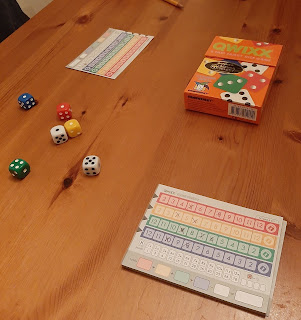
  Qwixx is a colored dice game from Gamewright, just six dice and a score pad. You can check it out here , even read the full rules.  Basically, there are two white dice and four colored dice, which match up with the four colored rows of numbers on the score cards.  The flow is that on each turn, the next player throws the dice.  All players get a chance to score the two white dice.  Then the player who rolled gets to score a combination of any white die and any one colored die.  So, everyone gets the white 2+4=6, then the active player can try to score an extra box of maybe white 6 plus blue 4 to get the blue 10.  The non-active players don't HAVE to score anything, but the rolling player must score one number on their turn or take a 5-point penalty box.  The genius of the colored scoring rows is that the top two rows go from 2 up to 12, and the bottom two rows go from 12 down to 2.  If they all went from 2 to 12, you would just alwa...

Dig

Image
Dig is a fun little game of doggies digging bones out in the yard.  It is one of a series of tiny games -- each half the size of a normal deck of cards -- from Pack-O-Game .  They are surprisingly interesting games for their size.  Basically, for Dig, you put all the tiny cards in one long row.  Then you each play a dog who gets up to 3 actions per turn: Move, Dig or Drop. It has a cute feel to it overall.  Just grab bones, drop them in the matching colored bowls, and have fun. But there is some strategy here, since the final scoring is based on the order in which the dog bowls end up.  Each time you dig a bone, you can replace it with a bone of your own, put it back, or keep it, cycling the very end card into its position.  So the order of the bowls will change as the game goes on. We find that the bowls usually scramble up without really trying, but it's possible to focus and move right next to the doghouse when the bowl I want is at the end of the ...

Cat Crimes

Image
 CAT CRIMES was an unexpected surprise that we found in the kid section at Barnes & Noble.  It turned out not to be a head-to-head game but a series of logic puzzles to sort out with the cute little props provided. The rules say to take turns and read the clues to each other and keep track of who solved more cases, but it turned out we both had more fun solving the puzzles together.  The cards range from Beginner to Expert difficulty.  The clues get increasingly more cryptic as the difficulty goes up.  A beginner clue might be "Ginger is seated next to Tom Cat", while an expert clue might be "No cat with blue eyes is seated next to a claw mark" ... there are two cats with blue eyes, two claw marks ... but there always does end up being one solution that fits all the clues.  Flip the card and see if you figured out which cat did the deed.  The Expert ones are seriously tricky.   The fact that there are two seats at each side of the cat tab...