Posts

Yut Nori

Image
After reading about so many games from around the world and across history, one of my favorites for spare time is the game of Yut, which is a Korean traditional game whose origins are lost in the sands of time.  Different researchers say it dates back to the 4th century AD, or the 12th, from one region or another, based on an earlier game, or not ... these are beyond the scope of my gamer's toolkit, and Wikipedia doesn't seem able to sort it out either.  The game was introduced to Westerners by Stewart Culin in 1895 in his book on Korean Games, which can be found in full at Google books. There are some alternate names for the game, with Yut Nori appearing to be the most common, although it looks like yut nori means "yut game".  Other names include Nyout and Korean Yoot , and even Korean Ludo.  Cyningstan has a good page about it, and the Bead Game site has a page as well.  I'm sure I could find many more. Even the meaning of the game seems to have been lost...

Pirate and Traveller (1954)

Image
I first heard about this game a few years ago.  The first edition was 1911, but of course that one is $100+ if you can find it at all.  The 1936 edition is almost as pricy, but I was finally able to get the 1954 edition in near mint condition and set it up. First of all, I love moving pieces on actual maps.  I also enjoy being the geography textbook who can help anyone find any spot in any country, thanks to my lifetime hobby of collecting stamps from every country.  For some of the places I even found myself starting brief history lessons. This map is very well done.  It is not a graphical marvel by modern standards, but it captures the look of a page from an old atlas of the time period.  The travel routes are very well thought out, and match what I know of the history of trade routes.  The paths all make sense, and that skull in the South Atlantic Ocean fits where St. Helena or Ascension Island would be, so for a geography lover there's more than ju...

The Six Million Dollar Man

Image
This game was in that batch of unrelated games I got this week.  I wasn't expecting much from it, and it delivered pretty much as expected.  It is just a roll-and-move game with the most pointless deck of game cards I have ever seen.  The cards all just say Power, each one worth one Power point.  It also had one of those silly spinners from 1 to 6 where they could have just used a regular six-sided die instead. The game had a few twists, like splitting the path into four separate "missions", though the missions feel exactly the same.  At the end of each mission you have to spin over a four or five (depending on the mission) to move to the next mission or win the game if you're on mission four, and if you fail the roll you lose a Power card and try again next turn; after two fails we just move to the next mission to quit stalling.  The blurbs describing why you lose cards or lose a turn vary from one mission to the next.  We ended up just throwing the p...

New arrivals and side notes

Image
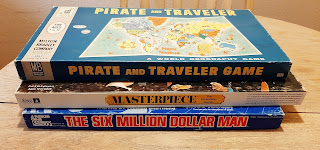
I got a batch of three old board games on eBay last week, and they showed up on my doorstep today in a nice chunky box.  I have no idea why the seller put these items together, as they are different themes from different decades, but here they are: The Six-Million Dollar Man, Masterpiece and the 1954 version of Pirate and Traveller (which I have been wanting to see for a while).  Unboxing, they were all in top condition and all the parts were there except Masterpiece was missing the value cards, but I could hop over to BGG to find a list of those and print them myself. First Looks: Masterpiece was the way I remembered it: an oversized board with paintings with values attached to them to buy or auction.  I'm not sure why it even needed the board.  A little deck of cards with those same phrases would do just as well.  I didn't see if there was a rule for landing on another player's piece.  If so, and that's the only reason there's a board, and the...

Odhams Press book of games

Image
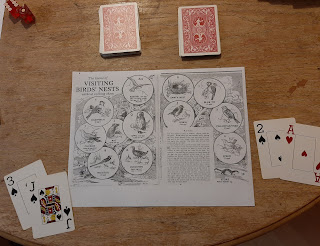
Looking into increasingly more obscure one-off games online, I came across The Children's Book of Games, Puzzles and Pastimes by Odhams Press, variously quoted as being printed in 1952, 1954 or 1959.  There are about 10 games from this book listed on BoardGameGeek and some fine articles over on Colganology . Odhams is an interesting publisher , ranging from mainstream magazines to Zap! comics.  I would like to see the whole book that these came from, but it's a $50-80 rarity right now.  The games looked trivial at first and yes, they mostly involve pulling cards from a deck and getting some points or moving a piece each time.  But they also feel like useful prototypes for more useful games.   My favorite of the batch has the eminently colorful name of The Game of Visiting Birds' Nests Without Robbing Them .  You pull cards, check the image for the matching bird or animal, which gives or takes some number of eggs.  Another twist is that you have to kee...

Utopia Engine

Image
Utopia Engine is a big, solitaire print-and-play game available at PnPArcade It is an impressive creation, with all the care that obviously went into it, and it has a big story about an artificer trying to rebuild a fabled machine to prevent Doomsday.  We were in the middle of the pandemic and I heard about it from one of many Youtubers who were talking about solo games -- that's how I discovered PnPArcade and Utopia Engine.  I played the two-page black and white version, though there is also a compact one-page version and a gorgeous full color PDF as well.  Check out its BoardGameGeek page for a look at these other layouts. At first, it was fun rolling the dice and following along in the rules to figure out which boxes to put the scores in, and how they add up to success or failure of each task.  By the end of the first page, I was finding some possible grey areas, just not sure if a certain combo could be scored or not, and I more or less just drifted off to other...

The Great Races, Sid Sackson 1978

Image
The Great Races is one of the one-page games created by Sid Sackson, published in Games Magazine.  This one was in the Jan/Feb 1978 issue.  It's what we would now call a "roll and write" game, where you roll dice and make some kind of markings on paper or a score sheet. It's not complicated.  The score sheet represents a series of horse races.  You take turns rolling four dice and splitting them into two combos of two dice for scoring.  You mark off boxes in the 2 through 12 rows as needed.  First one to complete a row gets the higher point score shown next to that row.  At that time, if another player is past the double line, they get the second place (smaller) bonus.  That's it. It starts off as just roll and write, but once a race is finished, it's finished.  If race 4 is done, nobody gets to score a 4 anymore.  So toward the end there's some competition for the remaining numbers.  You can eyeball the scores along the way, and sh...