Posts

SCRAM: cute cats for everyone

Image
SCRAM is a card game of cute cats, trying to score the best combos.  We goofed the rules the first few rounds, thinking we could have more than one active pile.  But there should be just one active cat, and when you score a cat you move it to your "Cat tree". The basic gameplay is: draw a card (from draw pile or one of the face-up cards in the "Pet Shop"), then either 1) add a card to your active cat if it's one more than the top card showing, or 2) throw a 0-point "stray cat" on an opponent's pile to slow them down, or 3) if you really have no moves, turn in your full hand and drew 5 new cards. Now, a stray cat can be immediately blocked by a Scram card, and you can "bank" a cat at any time by moving that pile to your cat tree and starting a new pile.  There are a few STEAL cards in the deck that let you take th top card from an opponent's stack if you can play it right away. Some of the cat cards have special rules printed on them, ...

Birthday Batch 2021

Image
For my birthday this year I did a trip to the nearby Barnes & Noble and a trip to the local game shop and found a variety of games to test out ... I have been wanting Azul for a while now, but wow just unpacking it, it seems unusually complex.  I also wanted to try one of those book-shaped games, and went with Baba Yaga, since that is a favorite piece of bizarre folklore.  Someone mentioned the noodles game, and it goes well with another ramen-themed game already on the shelf.  There are two word games, because my girlfriend and I really enjoy word games: WordSpiel I have already done a post about, and Scrabble Slam is coming soon.  Ogre Under looked cute, and Scram had cats.

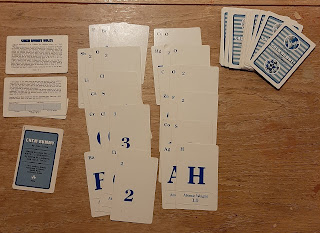
Chem Rummy (1974)

Image
Here is another super rare card game I have kept since I was a kid.  My dad was a chemistry teacher, so I have always had an interest in molecules and all the possible combinations of elements, and the ongoing research that pushes the boundaries of new types of chemicals. Here is Chem Rummy, from Addison-Wesley, 1974.  It's not even mentioned on BoardGameGeek, and I have no idea how many were printed or if they are still available.  I never could get another player to sit down and build chemical formulas with me, but the idea was to play exactly like gin rummy: draw and discard cards until you can lay down your whole hand of cards as a valid set of molecules. But I always played it like regular solitaire: make the seven piles of one to seven cards, play and move the cards exactly as in regular solitaire, turn the extra cards three at a time, and see how many combos I can make before the cards run out.  With this deck, you do eventually end up with just number cards a...

WordSpiel - making words with that last letter

Image
We did a test drive of a new card/word game this weekend, this time it was WordSpiel.  The basic idea is that you have to play a word using the last one, two or three letters of the last word played.  It started off easily: The rules show the words building into a perfect spiral around the draw pile, but, well, that's never going to happen.  What a pain... The first thing we decided was to reset the spread of played cards when it started to get too ragged.  Really, the game is so simple, there is no grand strategy, so we don't need to know every card that was ever played. There, nice and tidy.  Goodbye, impossibly neat spiral.  Anyway, it was an enjoyable way to burn through some cards on a sunday afternoon and make sometimes funny combinations of words.  The only other rule of note is that if you get stuck without a word you can trade in up to three cards as your turn, or flip the top card from the draw pile after you first say whether you are going t...

Disintegration (1974) - fun with nuclei

Image
Wow, I found a game that's not even mentioned on BoardGameGeek.  Disintegration is a science card game from Relativistics, 1974.  I had this when I was about 13, so I first saw it in 1979.  The idea is to take a chart of the nuclides (all known isotopes organized by atomic weight and neutron count), put your pieces on lead (Pb), and play cards to decay your way all the way down to Hydrogen (H) without going off the chart or hitting a stable isotope which could never decay further in nature.   Sure, that worked way back when.  It wasn't just nerdy, it was nuclear physics, with cards showing how alpha and beta decay and other nuclear events work.  Plus some cards called "Improbable process" where you can play combos that never happen in nature. The cards are still fresh and new... But we have since discovered hundreds of new isotopes.  So look at how crazy big the chart is now.  Even on a scale too small for the plastic pieces to fit in the squ...

Bali (1954) - card game making words

Image
I found a 1954 blue box version of the card game Bali in my collection of card decks.  Yes, if you put stuff away in the closet for years, seeing them again can be like going to the store.  Anyway, I remember trying it once before and being unimpressed, but this time we took some time to read the rules more closely and tinker a bit.  The tiny rulebooks from that era were full of ambiguous phrases, and just don't match the precision of modern rule sets now that decades of "rules lawyers" have hashed them out over gaming tables. It turns out to be a solid game.  Let's focus on the two player game, since we are a two player gaming group.  You get 7 columns of cards, like in standard solitaire.  Each column is called a "panel", so each player has 7 panels where they will be building words or parts of words vertically downward. The first few runs we tried it with just 5 panels, since it felt like 7 was too many. So, each turn you can add onto any ONE of your pan...

Annexing an old Blog about Words

For word gamers, I have brought back an old blog of mine about words with a four-part series on vocabulary building using the letters of four major world alphabets. Check out the English alphabet , Greek alphabet , Hebrew alphabet , and a curious lack of others over on my Word Fixx blog.